Flare, touchdown, nose wheel
A real airliner comes down to the runway along a line three degrees steep, roughly fifty metres of height for every kilometre. It doesn’t aim at the start of the runway. Painted on the concrete are aiming point markings, 150 to 400 metres in depending on the runway’s length, and that is where the crew points the aircraft. An A320 flies the final approach with its nose about two and a half degrees up. Some nine metres above the ground it starts to flare, touches down on the main gear with the nose a good five degrees up, and lowers the nose wheel about three seconds later. Raise the nose to almost twelve degrees and the tail scrapes the runway.
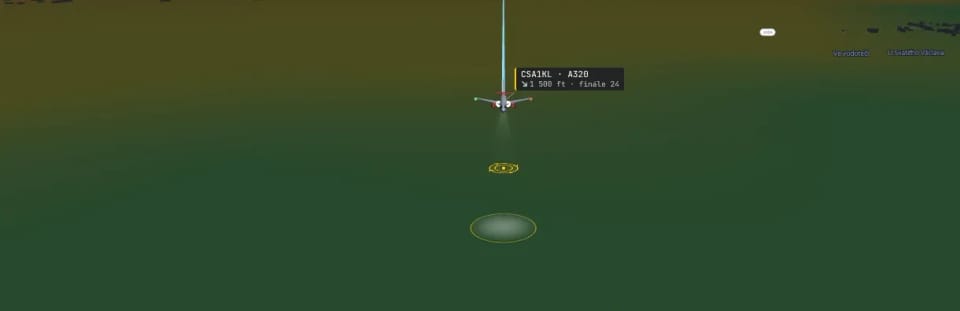
None of this is in the data. An aircraft reports its position, altitude and speed, and says nothing about its pitch or its landing gear. So the drawing knows how each type behaves and puts the attitude together from the phase of flight: nose up on approach, the flare, the main gear, the nose coming down. On take-off it runs level, rotates just before lifting off and climbs away nose high. And it touches down where real aircraft do. In Prague, London and Atlanta the drawing used to land about 300 metres past the start of the runway; now it is around 450, in the zone pilots actually aim for.
Each type does it its own way: an A320 differently from a Cessna, and a B-52, whose wheels sit one behind the other, almost flat. The gear isn’t retracted on short final, it goes up only after lift-off, and on a go-around the aircraft climbs away first before it tucks the wheels in. At the moment of touchdown a puff of smoke comes off the tyres, as on a real runway, where wheels standing still spin up to well over 200 km/h in an instant. Only a landing the data really confirmed gets it. An aircraft that powers up just above the runway and goes around stays clean, and so do take-offs, taxiing and helicopters. On one morning in Prague, 66 of 67 landings got their puff; the last one disappeared from the data 160 metres above the ground.
When the signal thins out
Up high an aircraft is heard by antennas a hundred kilometres away. Close to the ground it hides behind buildings, trees and hills, and positions stop coming. Even at airports with our own stations, reports around touchdown arrive anywhere from every half minute to nearly every four minutes. The last report comes from three kilometres out, the next one from the runway, a minute later and already slowing.
The aircraft used to hang over the runway in that gap and then jump. It crossed the start of the runway still high above it, dropped by up to 600 metres in a single frame when a report from the ground arrived, and rolled backwards. We replayed one whole morning at Prague, 153 movements. The old drawing jerked in 18,000 frames, rolled backwards 140 kilometres in total and spent twenty minutes hanging in the air. The new one, on the same data, didn’t jump once.
Now it follows the glide path in the gap, flares and touches down where a real one would, then brakes along the runway towards the exit a real aircraft would most likely take, a high-speed one angled off the runway if there is one. It never overruns the end of the runway. If a new position shows the aircraft further ahead, it speeds up gently; if it braked harder than the drawing expected, the drawing slows down and waits for it. It never rolls backwards.
We thought of the awkward cases too. A landing or take-off that happened between two positions plays out a bit faster until the drawing catches up. An aircraft never drives across the grass: if the only straight line to its new position runs over the lawn, it takes a short hop instead, because a brief jump is a smaller lie than a Boeing on the grass. And a helicopter that falls silent low over the airfield has most likely landed. After a short silence we set it down where it was, instead of letting it hover and drift away.
Lights and sound
Airliners switch on their landing lights below flight level 100, about three kilometres up, so that they can be seen, and switch them off above it. On the ground the taxi light shines from the nose leg. The aircraft doesn’t report which lights it has on, so in the drawing they follow the same operating rules: landing lights on the take-off roll, the landing roll and below FL100, taxi light while the aircraft moves on the ground. Parked aircraft and ghosts stay dark. The light cone exists only in the air and fades near the ground, so it never cuts into the runway.
Two details you would hardly notice. An aircraft cruising right at FL100 would flicker like a Christmas tree, so there is a small margin around the line. And La Paz sits higher than FL100: by the ordinary rule a landing aircraft there would never switch its lights on. Over high ground the lights therefore come on in the last kilometre and a half above the terrain.
Switch on the speaker and the airport starts to hum. A jet sounds like a jet, a turboprop, a piston single and a helicopter each have their own voice, and you hear the nearest few aircraft. The take-off roll is full thrust with a deep rumble, taxiing is idle, and right after touchdown you hear a short burst of reverse. An aircraft passing by sounds slightly higher as it approaches and lower as it moves away, like an ambulance in the street. The air swallows the high notes, so close up you hear the hiss of the turbine and from a kilometre away only a low rumble. Sound fades with distance a little more gently than in reality, so an overview from a kilometre up isn’t completely mute.
We use no recordings: every sound is made live in your browser, and nothing plays until you tap. An aircraft that stands still for a while goes quiet, and ghosts never make a sound. A hidden tab is silent, and so is a paused replay.
Tilt the map
Tilt the ordinary flat map with two fingers. The terrain switches on by itself, the aircraft rise to the altitude they are flying at, each with a shadow directly below, and the flat icon becomes a little plane with a body, wings and a tail. A helicopter’s rotor lifts above the cabin. If a device can’t draw the little planes, the flat icons come back on their own; an aircraft never vanishes from the map.
In a turn the aircraft banks: right turn, right wing down. Aircraft don’t report their bank angle either, so we work it out from how fast the aircraft turns and how fast it flies, by the same relation that governs a coordinated turn in real flight. An airliner banks by thirty degrees at most, as it does in normal service, a light aircraft or a helicopter by up to forty-five, a balloon not at all. Within the last thirty metres above the ground the bank fades out, and on the ground the wings stay level. An aircraft we hear only every few seconds doesn’t bank at all, because it would rock from side to side.
Select a flight and its track hangs in the air at the height it flew, with a translucent curtain down to the ground. You can see where it climbed, where it held, where it came down. Flatten the map again and the terrain switches itself off, and the icon is a symbol again.
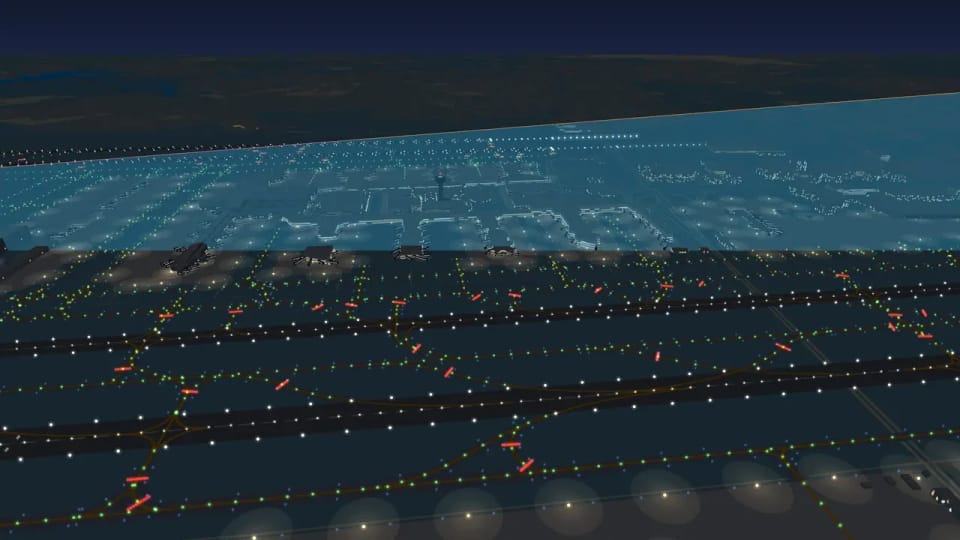
On one morning in Prague the old drawing would have rolled aircraft backwards 140 kilometres. The new one doesn’t roll them back a single metre.