A different network
An airliner announces its position over ADS-B and every antenna around hears it. A glider mostly keeps quiet. A transponder with ADS-B costs thousands of euros, adds weight and draws power from a battery that has to last a whole day in thermals, and it is only required in parts of the airspace. Glider pilots fly with FLARM instead: a small box that sends out its position and direction about once a second, so that two gliders circling in the same thermal see each other and don’t collide.
The same messages are picked up by the Open Glider Network, a network of ground receivers that volunteers put up mostly at gliding sites. It is a different network from ours, and none of its positions count towards any figure about our own. The data are open under the ODbL licence, and map.flights draws them in the Gliders and GA layer. They also feed the Small airfields layer, where a dot next to a field says that someone flew from it today.
Gliding is a weekend sport, and the data show it at a glance. On Saturday 3 October more than eleven thousand glider flights from 641 fields came through OGN. On Monday 5 October it was a little over a thousand.
Every device has an entry in the OGN registry where its owner chooses whether anyone may show it and whether its registration may appear. If tracking is switched off, the aircraft isn’t on our map at all. If identity isn’t allowed, it is only an anonymous marker whose tag changes every day, and we treat an aircraft missing from the registry the same way: not being listed is not consent. After 24 hours, OGN positions disappear from the map, from the flight pages and from our API.
We thought about echoes, too. OGN receivers forward ADS-B as well, so at first the glider layer filled up with copies of airliners the map already draws. On 9 September, 564 of the layer’s 731 targets over Europe were such copies. Today an aircraft that our ADS-B hears doesn’t appear in the glider layer at all.
White glass fibre
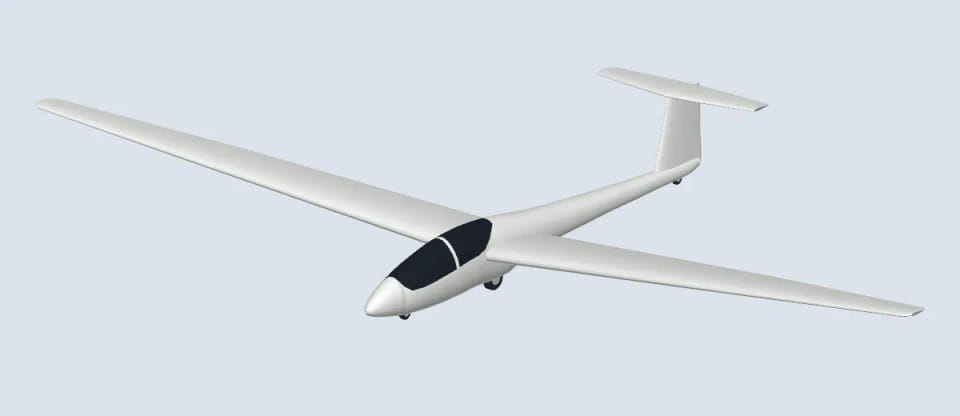
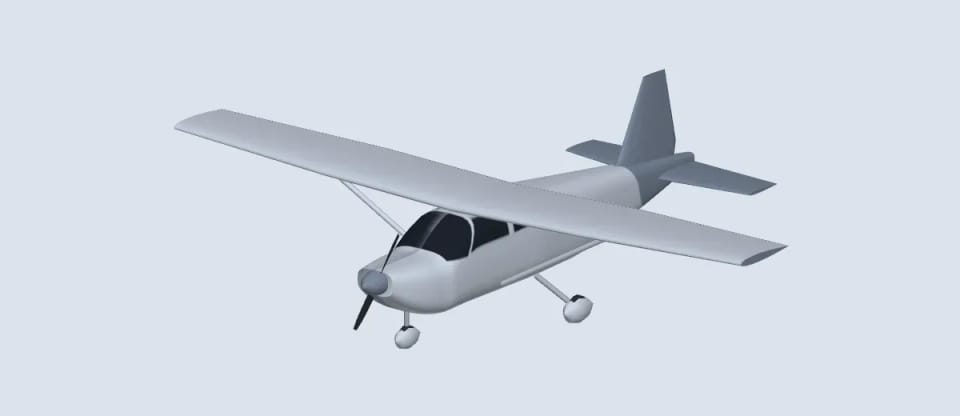
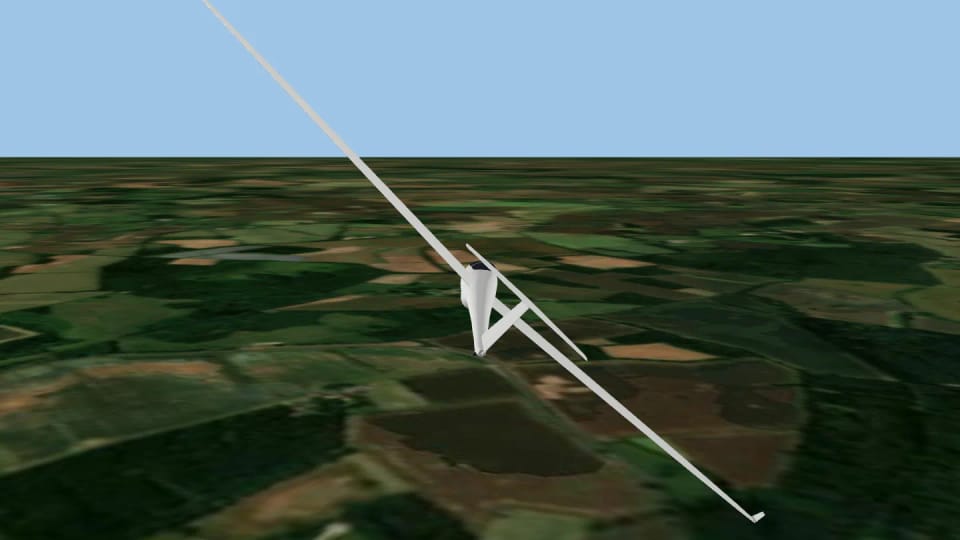
As late as early October, the 3D view drew a glider as a generic light aircraft: a propeller in the nose, struts under the wing, fixed landing gear. A real glider looks nothing like that. Its fuselage narrows behind the cockpit almost into a pole, its wings are fifteen to eighteen metres long and thin as a plank, most have a T-shaped tail, and underneath there is a single wheel.
Now it has a shape of its own. From freely licensed drawings and photos of both sides we built the ASK 21, the glider that flies most often in the OGN data, the older ASK 13 of wood, steel tube and fabric, the single-seat LS4 and Discus, and two motor gliders that can take off by themselves, the SF 25 Falke and the Super Dimona. The type comes from the OGN registry, or from the type code with ADS-B; a glider we only know to be a glider gets a generic two-seater with an eighteen-metre span.
They are all white, and that isn’t laziness. Modern gliders are built from glass fibre and resin that softens in strong sun. A dark fuselage would heat up on a summer airfield, a white one doesn’t. Only the wingtips and the nose tend to carry a bit of colour.
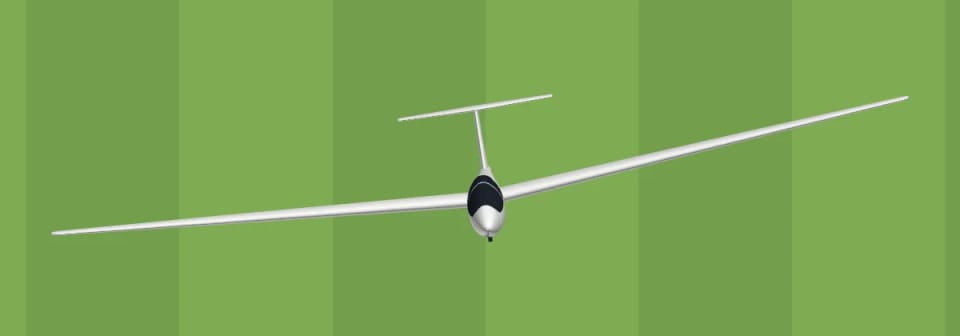
On the ground a glider doesn’t stand level. It can’t balance on one wheel, so it rests on the tip of one wing. Ours does too: we work the angle out from the shape of each type, so an ASK 21 leans by nine degrees and an ASK 13 by eleven. Which wing it rests on is fixed for each aircraft, so it doesn’t flip sides every time you look again.
At take-off a helper runs alongside holding the wing level until the glider has enough speed. Our model levels out just as smoothly during the take-off run. The Falke and the Dimona have two wheels and stand level, as the real ones do.
The rope
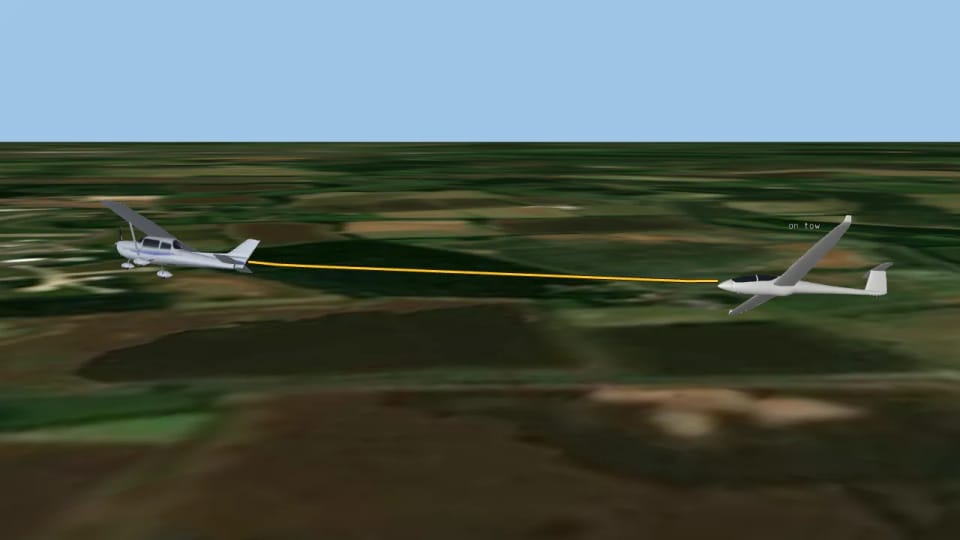
Most gliders get into the air behind a tow plane. It pulls them on a rope a few dozen metres long up to four to six hundred metres, where the glider pilot releases. In the data, though, these are two aircraft, two dots with nothing in between. The rope is something we have to supply.
We recognise a tow by how the two fly: a glider and a powered aircraft close behind each other, on the same heading at the same speed, both climbing. Between them we stretch a rope of real length, and we draw both aircraft at the same instant, so the rope never ends in mid-air.
A rope isn’t a pole. While the tug pulls, it is taut and almost straight. When the glider catches up with the tug, it goes slack, sags and ripples, just as in reality, where it is a moment glider pilots fear, because a slack rope can snap tight. After release the free end with its ring drops below the tug, which drags it along for a while, and then the rope disappears all at once, without fading.
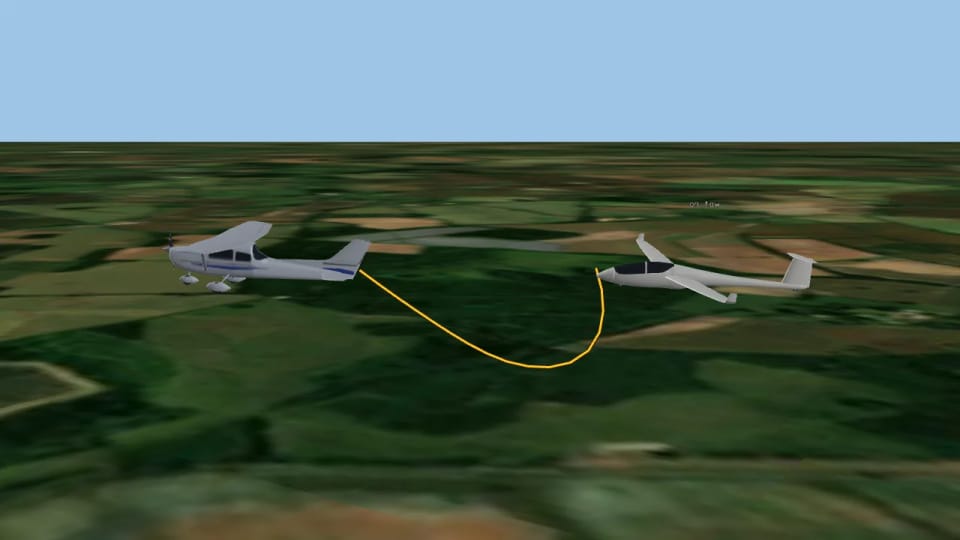
Meanwhile the aircraft bank. In a turn both lean over the way their speed and rate of turn demand, and the glider behind the tug banks a moment later, once the rope pulls it into the turn. On tow the banks stay gentle. Alone in a thermal a glider leans over much further, past forty degrees, and circles.
With a glider from OGN that is harder to show, because its position arrives only once every few seconds. The circling still shows; we just have to piece it together from sparser points.
We also thought about when not to draw a rope. Two gliders circling close together in one thermal are not a tow. Nor are two powered aircraft in formation, let alone gliders parked side by side on the grass before take-off. And when a glider is launched by winch, there is no second aircraft in the data, so there is no rope either.
After landing
A glider pilot lands, pushes the glider into the hangar and in the evening wants to see how the flight went. That is why every glider flight from OGN has a page of its own on map.flights. It opens from the airfield’s logbook, from the glider on the map, or from a link pilots send each other.
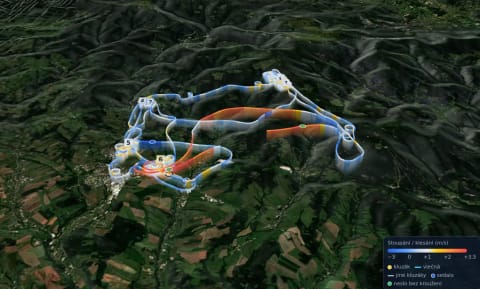
The page shows the track on the map and in 3D over the pilot’s own airfield, with a curtain down to the ground coloured by how fast the glider was climbing, and at the start also with the tug’s track, when the tug is in the data too. It tells how the glider got airborne: behind a tug, on a winch, or under its own engine. Every thermal has a number, its average climb, the height gained and the number of turns, and from the way the wind drifted the thermals we work out where it was blowing from at different heights and how hard. The glides between thermals show the glide ratio the glider actually achieved.
Below that comes what went well and what could have gone better, each line with a number and with how sure we are, and why. Where more gliders were up, the page shows how the air was working for them too, always anonymously. And after 24 hours it disappears, together with the OGN positions.
After release, our rope doesn’t just vanish. The free end with its ring still flutters behind the tug for a while, as it does over a real airfield.