Wheels on the runway, engines above it
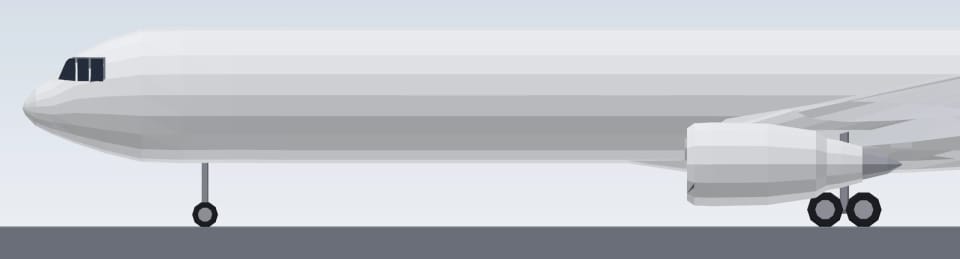
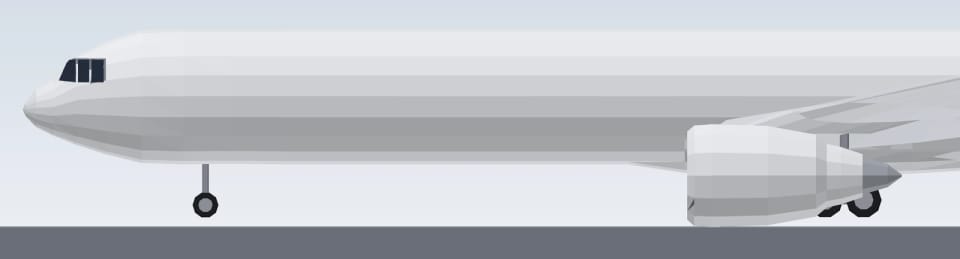
A real airliner touches the ground only with its tyres. Everything else hangs in the air, and on today’s narrowbodies it is tight: the huge engines only just fit under the wing, with little room left between nacelle and concrete.
In 3D that wasn’t true for a long time. On 36 jet types the engine nacelles came out 20 to 65 percent fatter than they should be, and on 35 types an engine or a propeller reached lower than the wheels. The aircraft then rested on whatever was lowest. A Boeing 757 rested on engines that would have sunk 27 centimetres into the concrete, with its main wheels left in the air.
Today the nacelles match the real engine diameter to within five percent. The A350’s shrank from 4.46 to 3.70 metres, the Embraer 190’s from 2.21 to 1.80 metres, and 58 types got longer landing-gear legs. There are now 37 centimetres of air under an A320neo’s engine, 43 under a 757’s and 61 under an A350’s.
We check it on every type with a detailed model, on the detailed model and on the distant one. The bottom of the wheels sits on the runway surface to within two centimetres, even while the aircraft touches down slightly nose-up. The whole aircraft checks out too: from the wheels to the top of the fin, a model is within 0.6 percent of the real one’s height. So it holds on the stand, at the moment of touchdown and during the take-off run.
Spoilers on touchdown
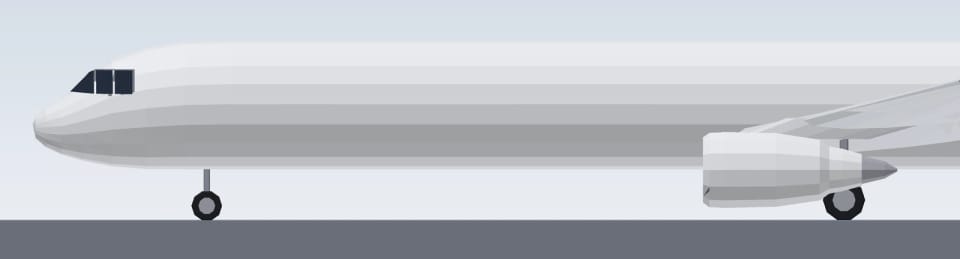
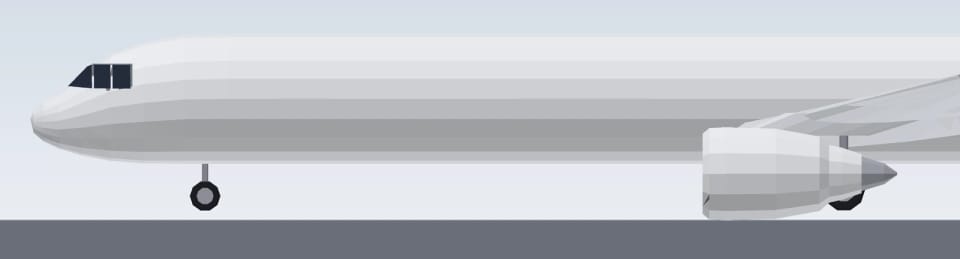
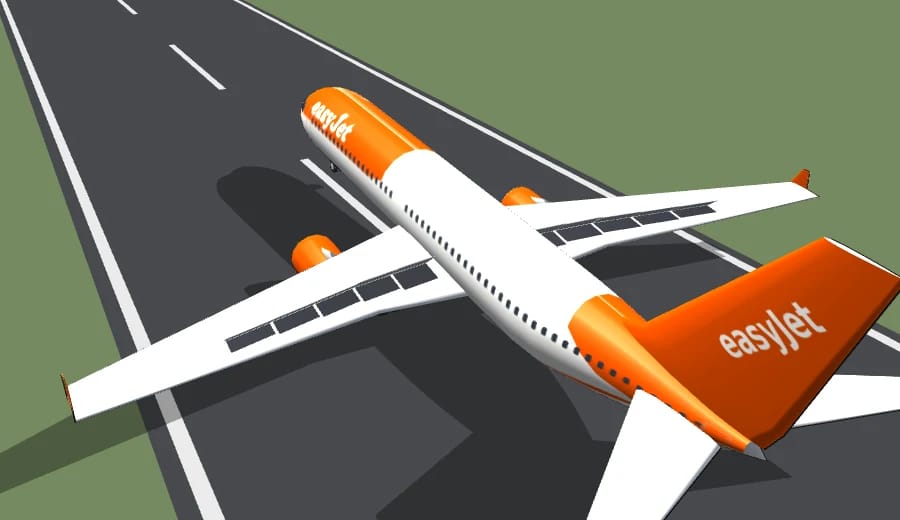
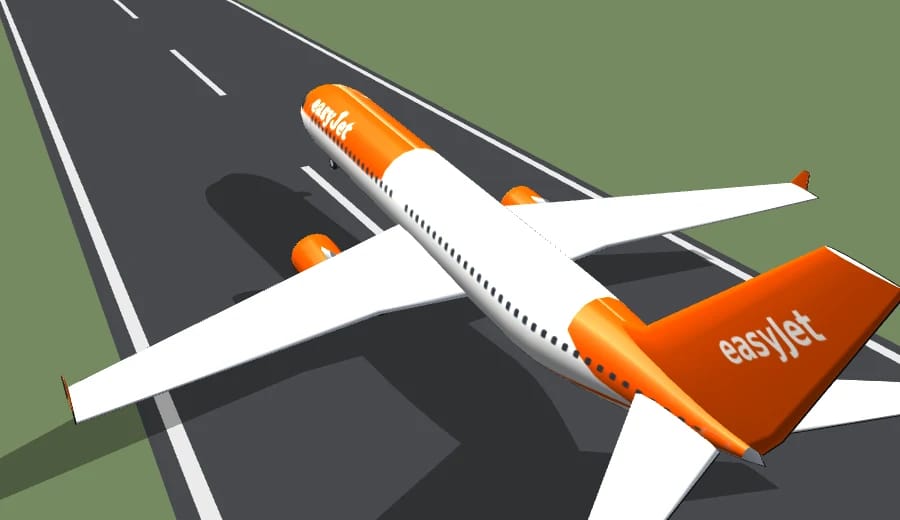
The moment a real airliner’s main wheels touch the runway, a row of panels flips up on top of both wings. The spoilers kill the lift, press the aircraft onto its wheels so the brakes have something to work with, and add drag of their own. They stay up until the aircraft has slowed down and is turning off the runway. In a rejected take-off they come up too; on a touch-and-go they stay down.
No aircraft tells anyone whether its spoilers are out, so we draw them from what the aircraft is doing: they rise once the data show it really is on the runway on its wheels and braking. How many panels you see depends on the type, just as in reality. An A320 has five per wing, a Boeing 737 six, the 777 and 787 seven and the A380 eight. The panels sit on the actual wing of each model, never cut into the fuselage or an engine, and under every raised one there is a dark gap. The simpler distant model gets them too.
The data can be misleading here, and we planned for that. For a moment a take-off run looks just like a landing roll: an aircraft on the runway at high speed. So the spoilers wait for real deceleration, and across our test set of 58 departures they never came up on a take-off run. A touch-and-go looks like a landing for the first few seconds; as soon as the data show the aircraft speeding up again, the panels fold down before it even leaves the runway. And an aircraft that only appears halfway down its landing roll, because we never saw it touch down, gets its spoilers the moment it is clear that it is braking.
And the ATR? It has a single panel on each wing and uses it only for roll control; it doesn’t go up as a spoiler on the ground. So our ATR keeps it down after touchdown as well. The Dash 8, on the other hand, raises two panels on each wing outboard of the engine. A type whose panel count we haven’t verified gets none rather than made-up ones. By 30 September 70 types had spoilers.
Propellers, wing and a tailwheel
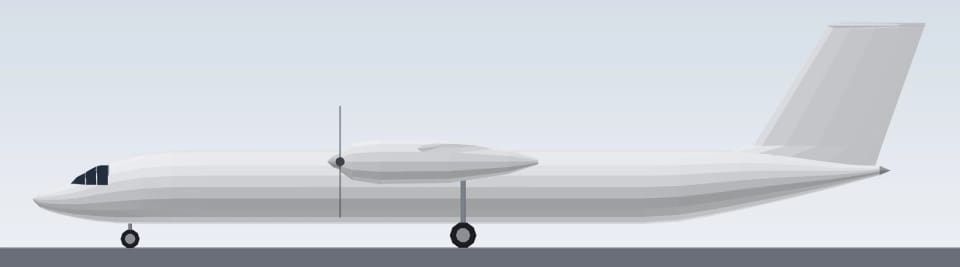
Turboprops are a different world. Propeller blades need a safe distance from the concrete, so high-wing aircraft such as the ATR or the Dash 8 carry their engines high, under a wing that sits on top of the fuselage. On the Dash 8 the bottom of the engine nacelle is 2.3 metres above the wheels; on a jet A320neo it is under forty centimetres.
The ATR, the Dash 8, the CN-235, the C295, the An-24, An-26 and An-32 and the C-130 have their propellers, wing and main gear where the real aircraft have them. For the Dash 8 we measured the positions from freely licensed photographs. The Cessna Caravan carries its propeller in the nose, low over the ground, and it used to reach ten centimetres below the wheels. Today there are 30 centimetres between the blade tip and the runway.
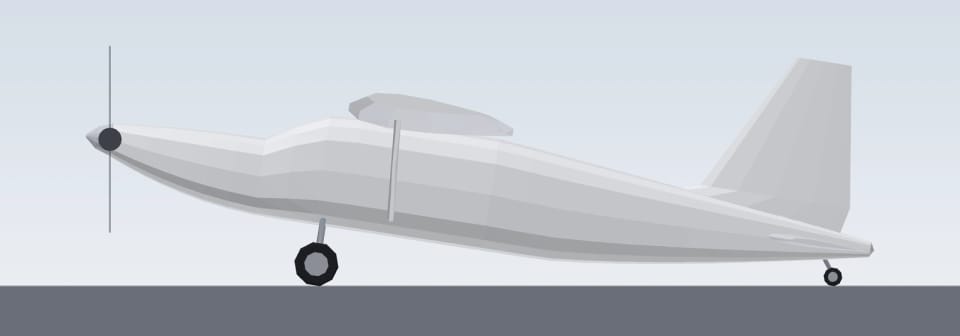
The Pilatus Porter, the An-2 and the Piper Cub belong to the old school. Instead of a nose wheel they have a small tailwheel at the back, so on the ground they sit on three points with the nose pointing at the sky, and the pilot can’t see ahead over it while taxiing and weaves from side to side. Ours stand the same way, nose up.
Shadows that follow the sun
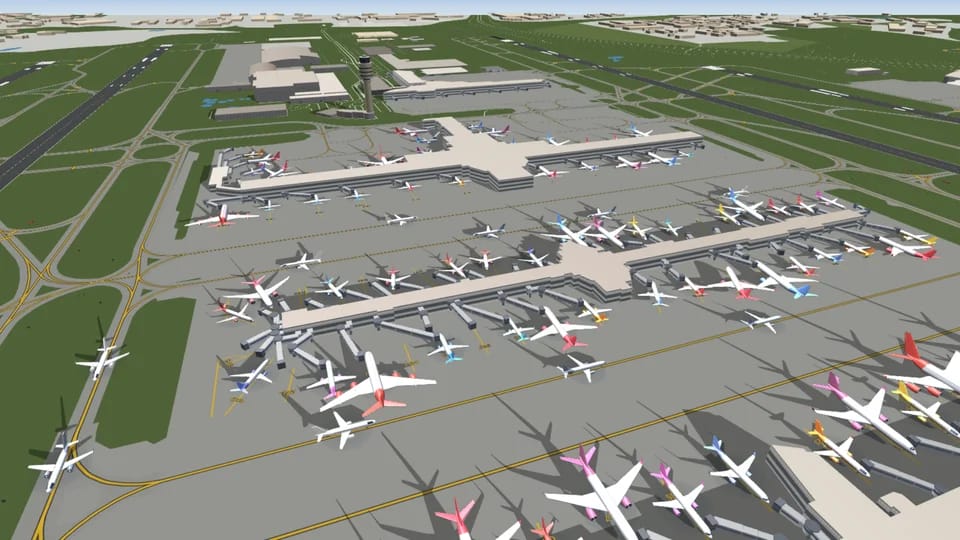
An aircraft’s shadow on the apron tells the time better than a watch. At noon it hides almost underneath the fuselage. In the morning and evening, with the sun low, it stretches across the whole apron: with the sun seven degrees above the horizon a shadow is eight times longer than the aircraft is tall, and the fin of an A320, just under twelve metres high, lays a dark band almost a hundred metres long across the concrete.
So in 3D every aircraft casts its shadow from where the sun really is over that airport at that minute. Prague, Atlanta and Dubai each have a different sun at the same moment, and in São Paulo the noon shadow points south, because in the southern hemisphere the midday sun stands in the north. Propellers cast shadows too, blades and spinning disc alike, and so does a helicopter’s rotor.
But a big airport has a lot of aircraft. In one view of Atlanta 102 of them are standing and taxiing, and each would like to cast the shadow of its detailed model, even one no bigger than a fingernail on screen. So aircraft further away cast the shadow of a simplified body; for an A320 it has about a tenth of the facets. It is still a whole aircraft with fuselage, wings, fin and engines, so even with a low sun its shadow is as long and as shaped as the detailed one, and the two overlap by about nine tenths. Only the landing gear and small details are missing, and on an aircraft a few millimetres long on screen nobody can tell. At medium graphics quality, 78 of those 102 aircraft cast it.
There was an even cheaper shortcut: a flat outline laid on the ground. But an outline has no fin, so with a low sun it would lose exactly the longest part of the shadow, and an A320’s shadow would shrink to a third of its area. Bring the camera closer and the shadow would suddenly triple. We didn’t take it. The aircraft you click on always gets its full-shape shadow, and close up the picture with the new shadows is the same as before down to the last dot. And still, at an airport the size of Atlanta, shadows now take roughly half the graphics work they used to, so 3D runs more smoothly on slower devices too.
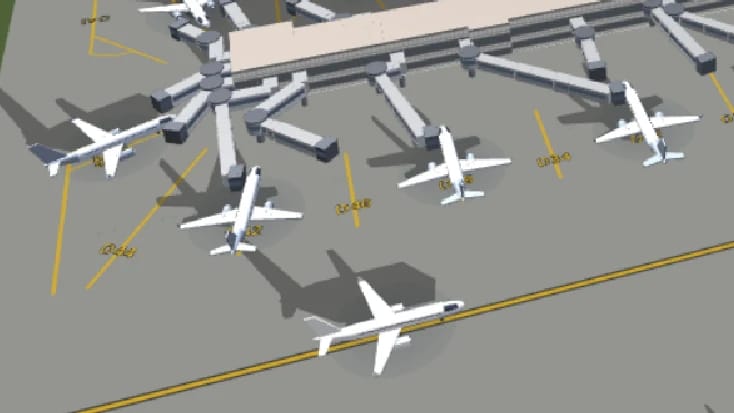
On 36 jet types the engines were up to 65 percent too big. Now they match the real diameter to within five percent.