The aircraft doesn’t say what it is
An aircraft tells the world a lot about itself: position, altitude, speed, callsign and a unique address that its country of registration assigned to it, a bit like an identity number. It adds a rough category too: light, large, heavy, helicopter, glider. What it never says is its type. We look the type up by that address in aircraft registers, and where we find nothing the map draws a plain arrow. The arrow is honest: we can hear this aircraft, but we don’t know what it is.
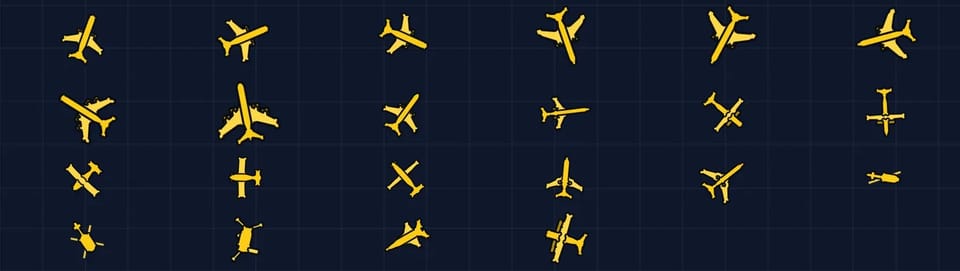
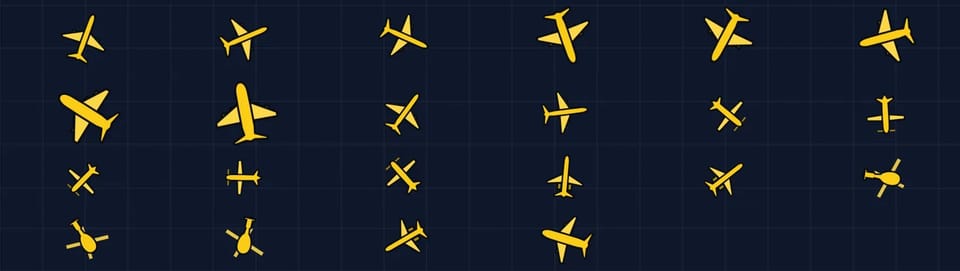
We started with eight silhouettes: narrow-body, wide-body, double-decker, freighter, business jet, propeller, helicopter, glider. The type should read from the outline, size and colour, because at that size any detail is lost anyway. Today the icon on the map is identical to the design pixel for pixel, on every screen.
Sharp at every angle
An icon turns with the aircraft’s heading, and that is harder than it sounds. An ordinary picture goes soft when rotated, loses a pixel here and there and seems to shrink or grow at certain angles. On a map where aircraft turn all the time, the whole sky would shimmer.
Our silhouettes stay the same size and equally sharp at every angle, on any screen and at any zoom. An aircraft heading north-east looks exactly like one heading south, just turned.
Zoom out to a whole continent and the icon shrinks to sixteen pixels, so the map falls back to a handful of simplified shapes. One rule holds even there: a jet has no propeller. From far away a business jet must not look like a Cessna, otherwise the map over Europe would be wrong about hundreds of aircraft at once.
From 3D models back to 2D
A spotter tells an Airbus A320 from a Boeing 737 at a glance: the 737 sits lower to the ground, has a sharper nose and differently shaped cockpit windows. From above and at icon size none of that survives. At 32 pixels the outlines of the two aircraft overlap by 95 percent, so a shape per type would only bloat the drawing without telling you anything. Families do tell you something.
Once we had 3D models for the airport view, the obvious question followed: why not draw the silhouette straight from them? Since 26 September the map has around forty silhouette families, and each one is an exact top-down view of our own 3D model: narrow-body twins, the four-engined 747, the double-deck A380, three-engined MD-11s, regional jets with engines at the back and a T-tail, ATR turboprops, helicopters by size, the tandem-rotor Chinook, or deltas with canards like the Eurofighter and the Rafale.
A view from above shows only what can be seen from above. On high-wing aircraft like the ATR or the Dash 8 the wing hides the underside of the fuselage and of the engine nacelles; on a low-wing aircraft the fuselage covers the wing root instead. So that the icon doesn’t lose its wingtips and tailplane, the fuselage and wings are drawn a little thicker than in reality, just enough for the shape to survive in a few pixels.
Icon size follows the real type, but more gently than reality does. An A380 is almost nine times longer than a Cessna 172. Draw it nine times bigger and either the Cessna becomes a dot or the A380 covers half the airport. This way a big aircraft is obviously big and a small one is still readable.
Rotors that really turn
A helicopter’s main rotor turns hundreds of times a minute and a turboprop’s propeller faster still. Pictures of spinning things can lie: anyone who has seen a western knows the stagecoach wheels that roll backwards on film. All it takes is for the wheel to turn by almost a full gap between two spokes from one frame to the next, and the eye reads it the other way round.
Since 28 September every helicopter rotor and every propeller on the map spins, from the Cessna to the Hercules. A rotor is a softly tinted disc with two to five blades. Between two frames it only ever moves a little, far less than the gap between blades, so it never stops dead or runs backwards. Jets get nothing.
A helicopter standing on the ground has its blades at rest and no disc. If your device is set to reduce motion, the rotors stand still too. And an aircraft squawking 7700 for an emergency or 7600 for lost radio gets through every filter on the map: even if you chose to see only helicopters, an emergency doesn’t get hidden.
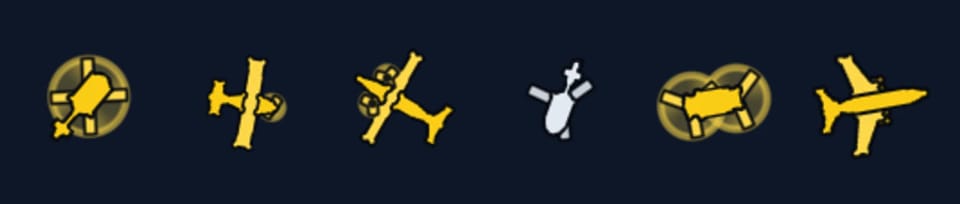
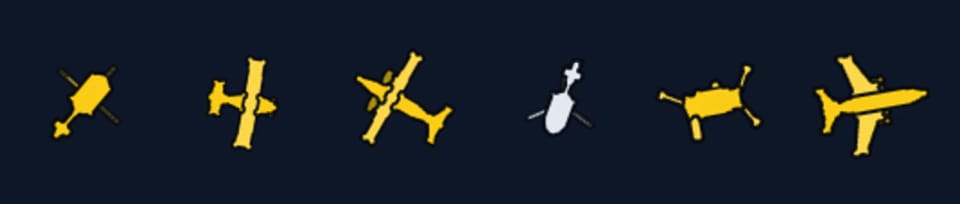
The struts under a Cessna’s wing are not in its silhouette, because you would not see them from above on the real aircraft either.