Every light where it belongs
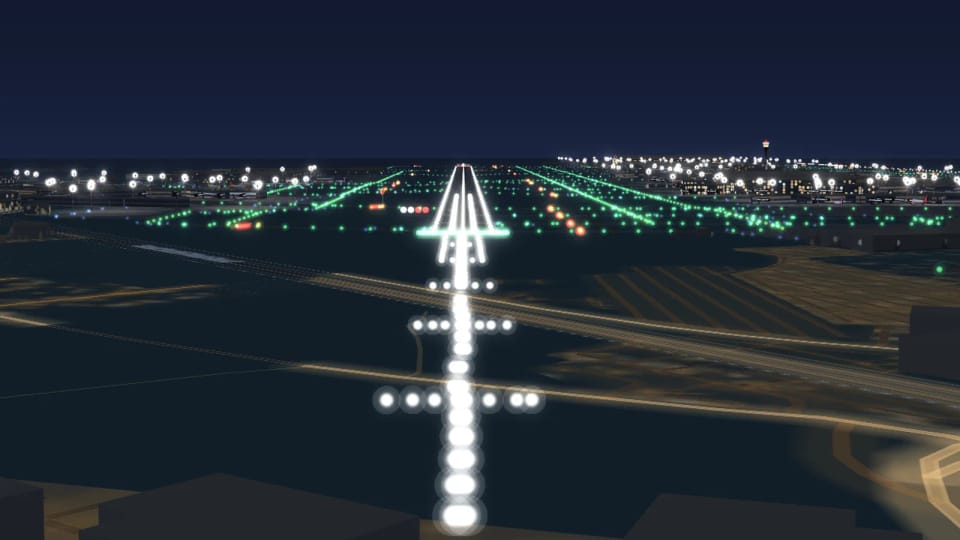
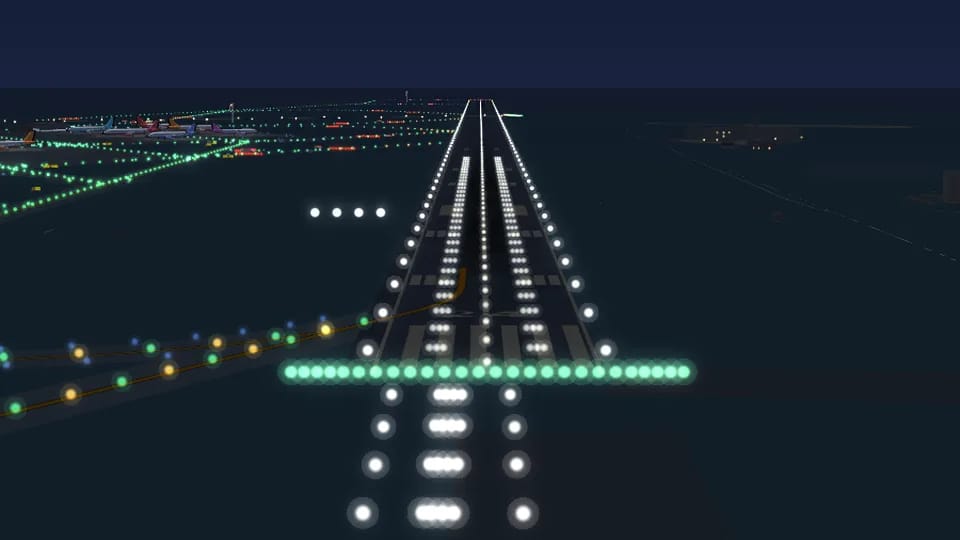
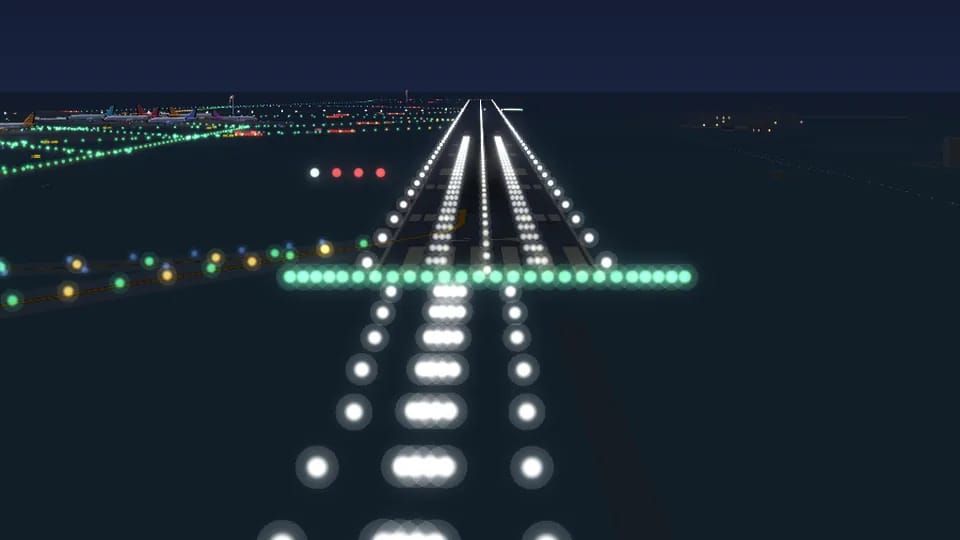
Airport lights aren’t decoration, they’re a language. Runway edge lights are white, and for the last six hundred metres yellow. The centreline is white, then alternates red and white, and for the last three hundred metres it’s only red, so the pilot knows how much runway is left. The start of the runway is green, the end red, and the lights point the way they should: a landing pilot sees green and white at the near end and red only at the far end. Taxiways have a green centreline and blue edges, and across the entry to a runway lies a red stop bar that nobody crosses without a clearance.
In front of the runway the approach lights lead the pilot in. A row of white lights along the centreline, crossbars, red side rows on the precision systems, and on many of them the ‘rabbit’, a flash that races towards the runway twice a second. Beside the runway stand the four lights of the PAPI. Two white and two red mean the aircraft is right on the glide path, four whites that it’s too high, four reds that it’s too low. In our scene the colour of each PAPI light is worked out from the angle the camera sees it at, so if you swoop in too high, you get four whites.
Not every runway end has the same system, and that is where we learned the most. Our first version guessed it from the size of the airport, and at three runways in Los Angeles the data proved us wrong: by their length you would expect the long system with red side rows, but they really have a simpler one, steady lights for the first four hundred metres and then only flashes. Today each runway end gets the system it actually has, wherever open aeronautical data or OpenStreetMap know it, PAPI included, in its real place and at its real angle. Where nobody knows, we draw at most the simple kind and never invent a precision one.
And not every end is lit. At a real airport the approach lights burn at the end that is being landed on. We can tell which one that is from the traffic, so at the other end the approach lights, the rabbit and the PAPI go dark, while the runway itself stays lit. What we don’t know is which lamps are switched on at this very moment, so the scene shows how the airport is normally lit, not a live switchboard.
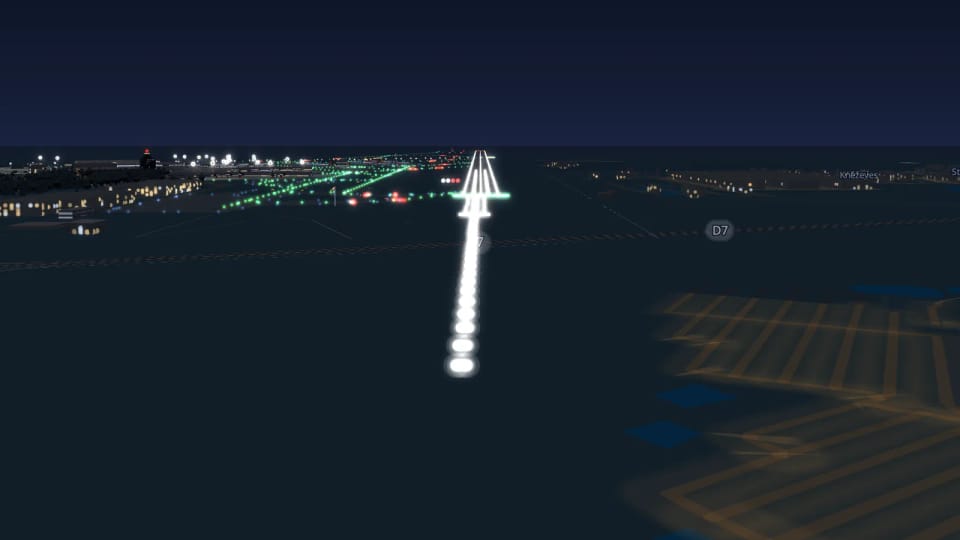
PAPI is easiest to read from close up. From the same spot 350 metres before the runway threshold, a little above the glide path all four lights are white, a little below it one is white and three are red. Where a runway has no approach lights, a pair of white flashes can mark where the runway begins, and we draw them only where the data say so, or in the United States, where they are common. Between the runway and the holding point the taxiway centreline alternates yellow and green, and a taxiway that is out of use stays dark, as does an old runway the map now shows only as a paved area.
Masts, windows and aircraft
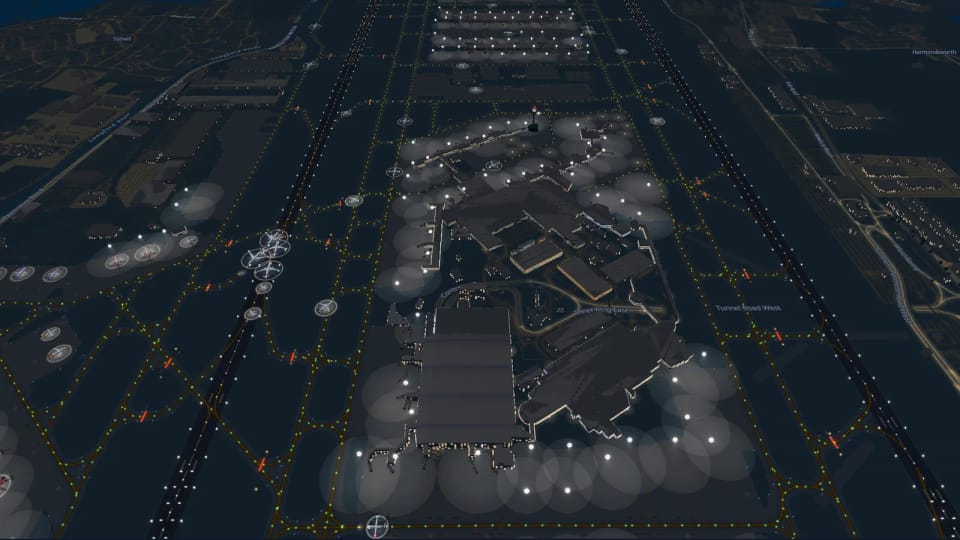
Stands are lit by tall masts with a bundle of floodlights on top. Ours have red and white striped shafts, like the real ones, and under them warm pools of light on the concrete. They stand by the terminals, not out on remote cargo aprons, and never inside a jet bridge. By day they stand there too, just switched off. Map data doesn’t say where masts are, so their positions are our estimate. A parked aircraft under them is lit from above, a bright back and fin with the belly in half-shadow, and it casts a shadow away from the nearest mast.
The aircraft carry their own lights: red on the left wingtip, green on the right, white at the tail, a red beacon and white strobes, each aircraft blinking in its own rhythm so the airport never flashes all at once. Landing lights come on for the take-off run, the landing roll and low over the ground, and go out higher up; on the ground the taxi light shines while the aircraft moves. A parked aircraft with its engines off doesn’t light itself, the masts do that.
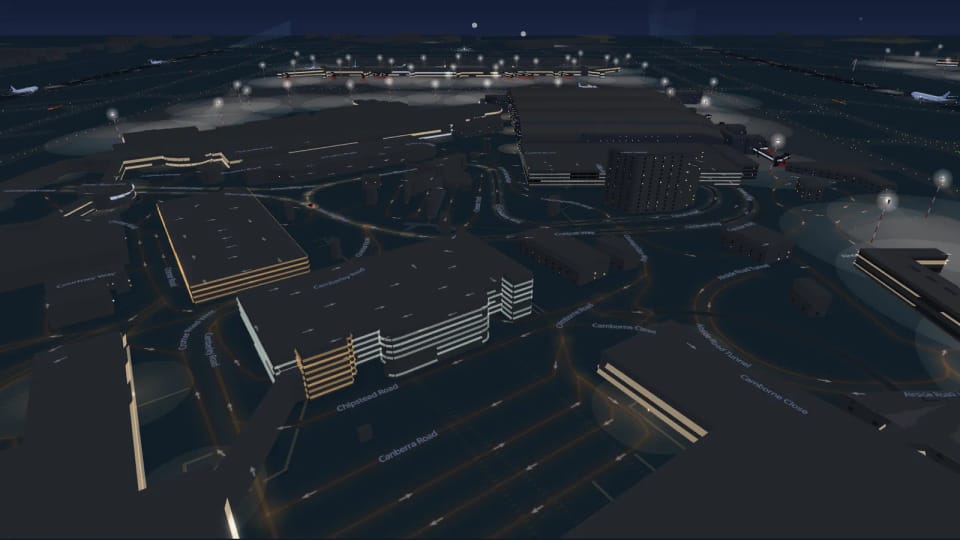
At the runway entries, wig-wags blink, pairs of yellow lamps that alternate about fifty times a minute, each pair in its own time. And the buildings light up, not at random. A control tower has only its glass cab lit, a terminal a band of glazing on each floor, a car park strips along its decks, offices and hotels a scatter of single windows with only some of them on, and a hangar a few lights above the doors, with the inside lit when the doors are open. It started when one Los Angeles terminal had six rows of windows as if it had six storeys. Now we count the floors.
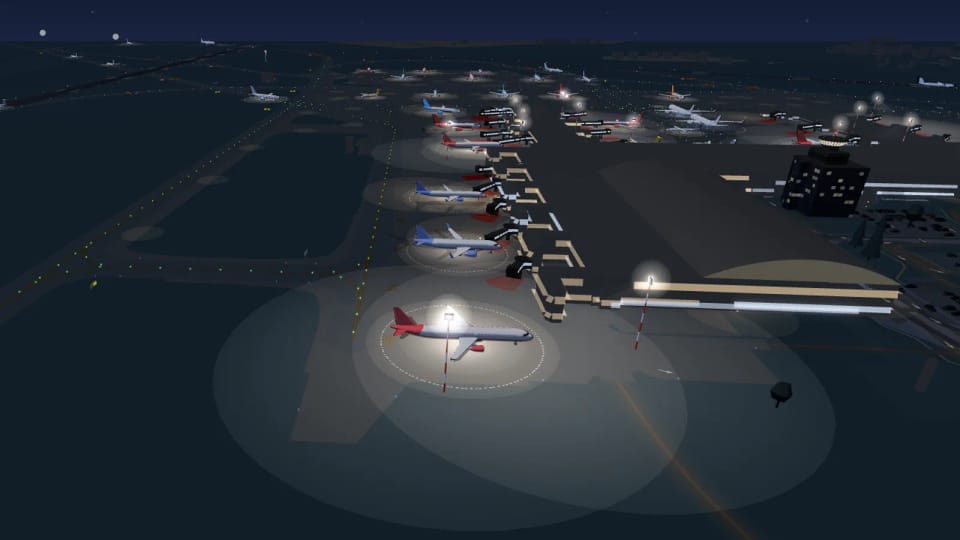
The control tower in Prague also glows at its glazed base, floor by floor. Windows don’t flicker as you turn the camera, and seen from high above they fade out smoothly so the outlines of the buildings don’t run together. Aircraft on the ground get a thin light ring around them at night so they don’t get lost among the airport lights. On the lowest quality setting, the one a phone usually gets, the parked aircraft cast no shadows.
Masts up close
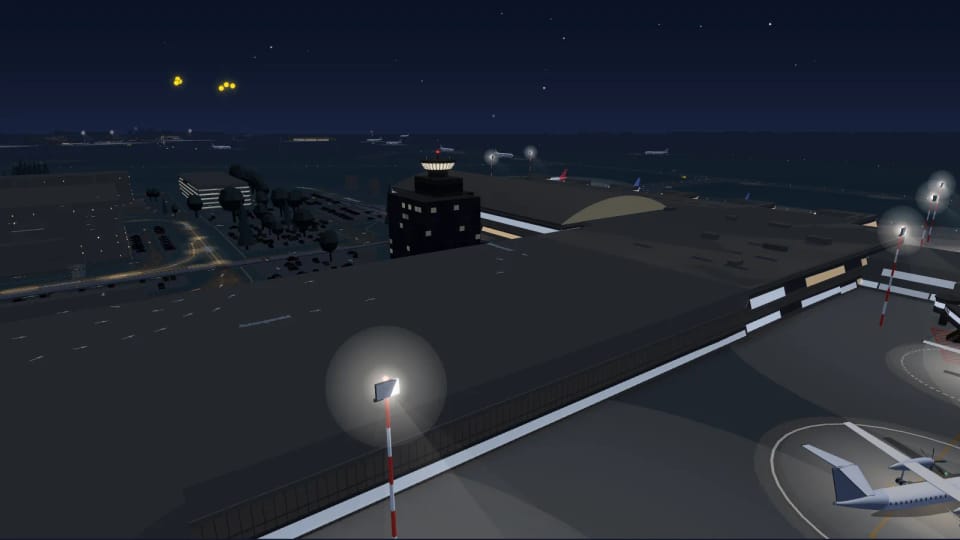
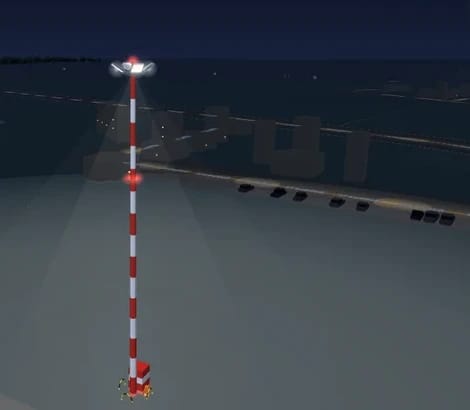
Up close, one apron mast is not like another. A tall one carries its floodlights on a crown: a cross of four arms, or a ring of lamps around a small platform, sometimes on two levels. By a terminal stands a slender pole with a T-shaped head that lights the apron and never the glass, and a small airfield gets a plain pole with a short stack of lamps. At the foot of the mast is a plinth with a cabinet.
At night every lamp throws a cone of light onto the concrete and glows with a soft halo. As you fly closer the halo of the whole head hands over to the glow of the single floodlights, without a jump.
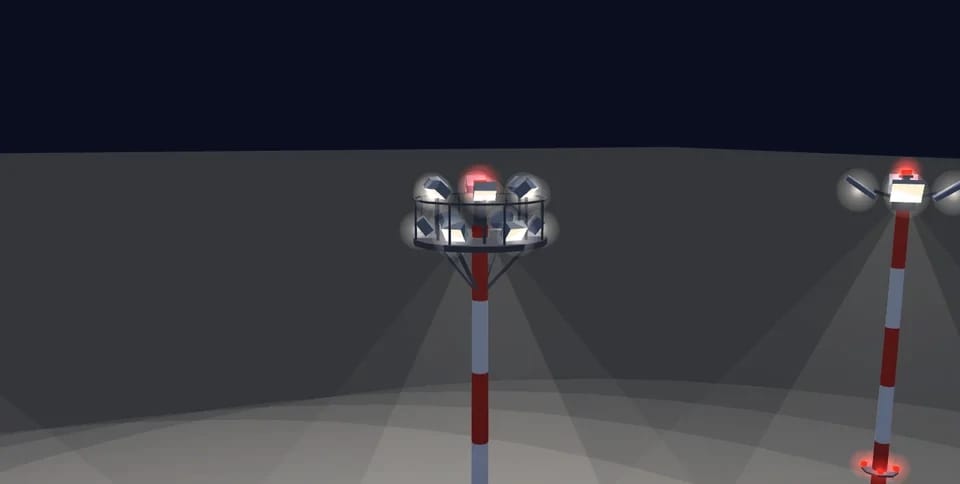
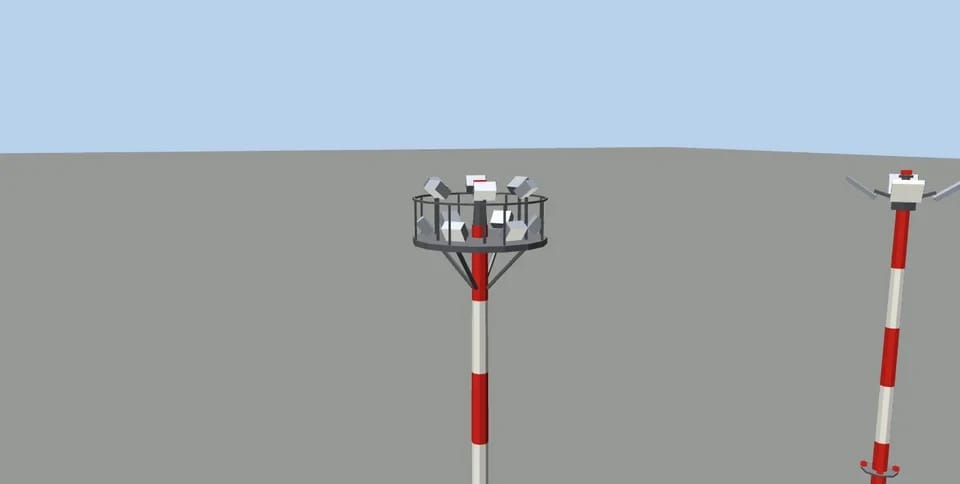
On the stands in Prague the same mast stands at the edge of the apron, with red obstacle lights at the top and halfway up the shaft.
Dusk, and the villages light up
Night doesn’t arrive with a click. The scene knows where the sun is above each airport, live and in playback, and day fades into night the way it does outside. The ground darkens before the sky, the airport lights come on before it is fully dark, and for a while the horizon is still bright while the runways already glow. Above it all the Moon shows its actual phase, bright side towards the sun, and stars come out only when the latest report says the sky is clear.
Then the streets light up, and for a long time we got this wrong in a way you only notice when you fly in at night. Every road glowed orange according to its class, so from above Buštěhrad, just west of Prague airport, bright bands ran across the fields from one village to the next. Fly over Czechia at night and you see islands of light with darkness between them: the lamps stand in the villages, the road across the fields is dark almost everywhere, and you can tell it’s there at most by the headlights of a car.
So now built-up land decides: housing, shops, industry, schools and hospitals, because factory sites and hospital grounds stay lit all night. The light follows the street, not the whole road. The stretch through a village glows, and the moment the road leaves the last houses behind, it goes dark. Where the map draws a city only as streets, as it often does in India or the Middle East, the density of streets gives it away, otherwise Delhi would stay as dark as a field. We checked it against the streets the map knows to be lit: they still light up about 91 percent of the time, and wrongly glowing roads around Kladno, where the first complaint came from, fell from 18 to 8.5 percent. It won’t reach zero. At the edge of a village, where the houses thin out, the data simply can’t tell whether there’s still a lamp.
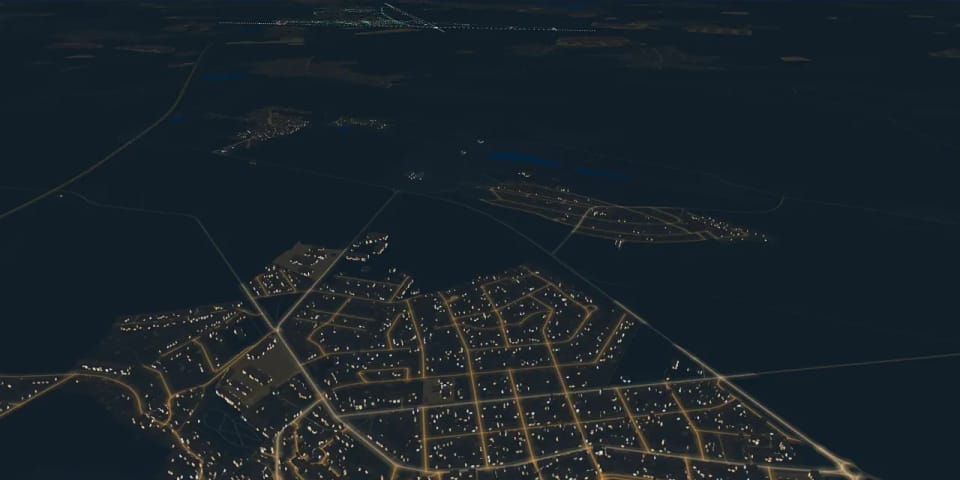
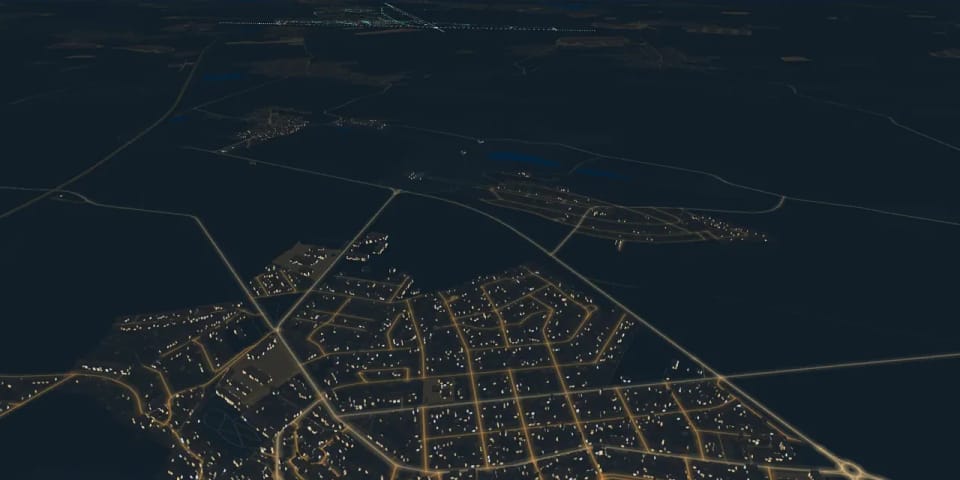
The lights around the airport are worked out only at night, and the town stays in the background so it never outshines the airport. Two hours of an October evening over Prague airport, squeezed into eleven seconds, show the order in which it all happens.
Swoop in too steeply and the PAPI beside the runway turns four white, worked out from the angle our camera sees it at.