For your eyes only
In the previous episode we cut transmissions out of the airband hiss and looked for the aircraft behind them. This one is about what the person who owns the receiver gets to see. They have a desk on map.flights that nobody else sees: not other users, not visitors to the airport profile. The recordings are their data, and what was said on the frequency belongs to nobody else.
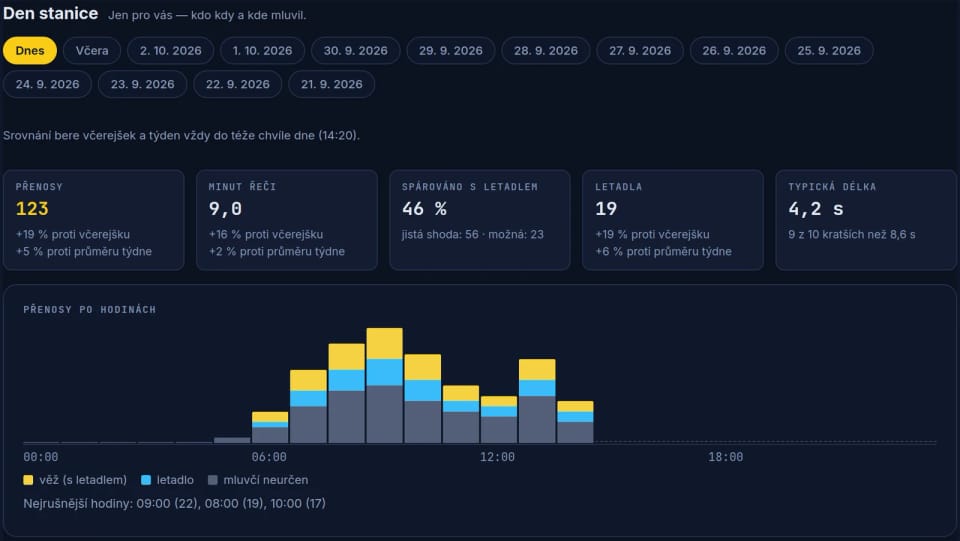
At the top is the station’s day. How many transmissions it caught, how many minutes of speech that was, for how many of them we know which aircraft was talking, how many different aircraft called in, and how long a single line usually is. A few seconds, typically: aviation radio doesn’t waste words.
Every number sits next to yesterday and the weekly average, always up to the same time of day. Comparing this morning with the whole of yesterday would be useless; at two in the afternoon every day would look like a slump.
The hourly chart tells apart who was speaking: the tower, an aircraft, or we don’t know. At a small airfield you can see the rhythm of the day, a morning wave of training flights, a quiet lunchtime, circuits again in the afternoon. An hour that hasn’t happened yet stays empty rather than showing a zero.
Who, and from where
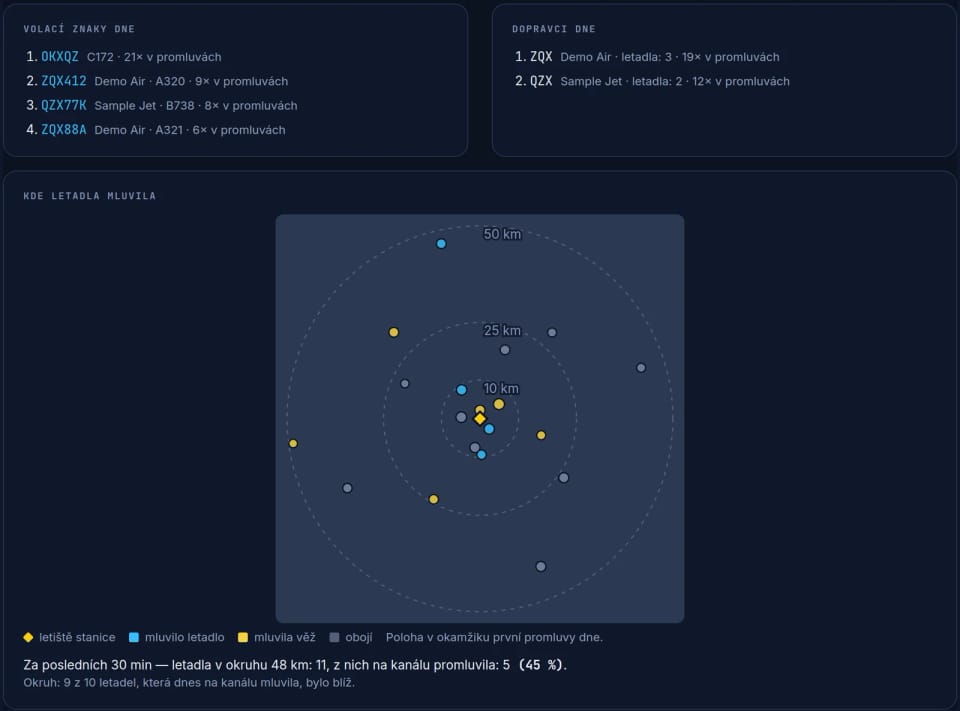
Below the chart are the day’s callsigns, ordered by how often they came up, and the airlines they belong to. Every callsign links to the aircraft’s page, so a single line on the radio leads to the route, the type and a photo.
The small map shows where each aircraft was when it first spoke that day, with rings at 10, 25 and 50 kilometres from the airport. An aircraft up high can be heard a long way off, while the tower stands on the ground and a receiver behind a hill won’t hear it. That’s why some stations hear the pilots’ answers but not the tower’s questions, and the colours on the map show exactly that: blue where the aircraft spoke, yellow where only the tower called it, grey for both.
Under the map is one line that says more about a station than anything else: how many aircraft were within range in the last half hour, and how many of them spoke on the channel. If aircraft are flying but aren’t in your recordings, take it as a hint, not a reproach: the antenna, the cable or the squelch.
Play it back
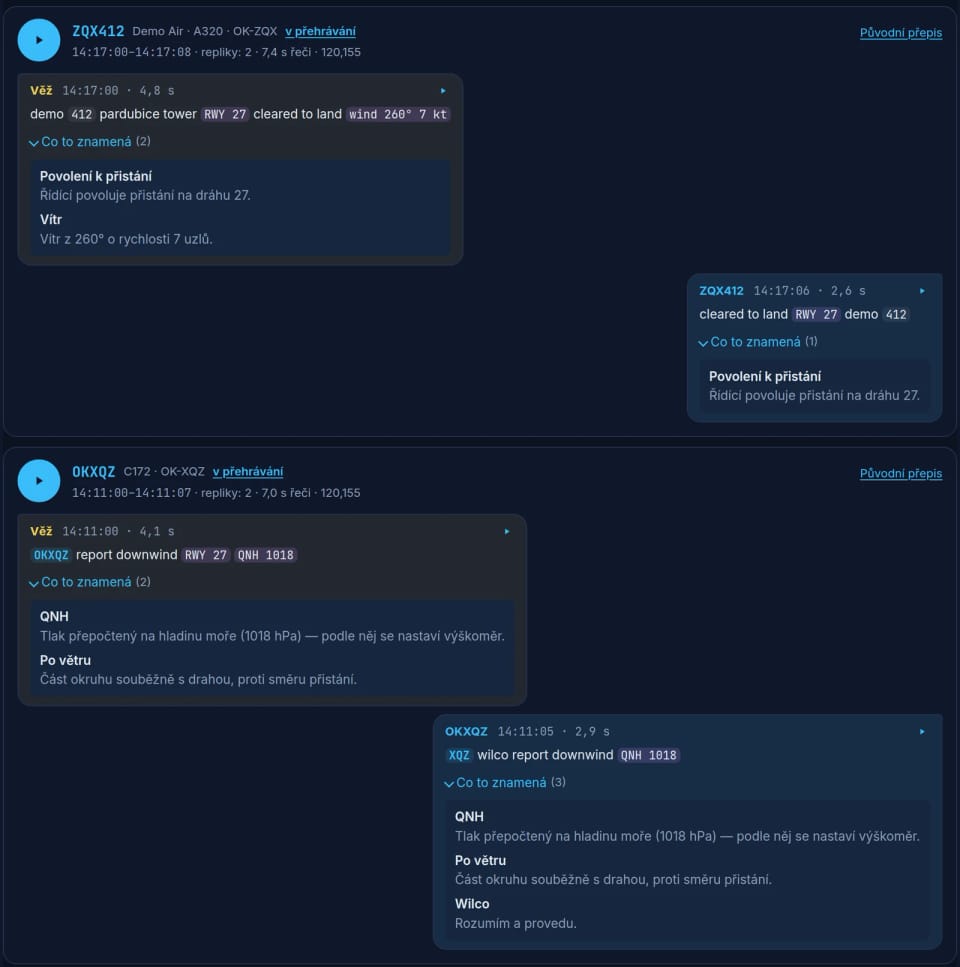
Listening puts transmissions together into short conversations, the tower on the left and the aircraft on the right, and one tap plays the whole conversation. Anyone who wants can listen to the frequency live, with the hiss reduced right in the browser.
The day can be searched. A callsign filter finds everything one aircraft said and everything said to it; a search in the transcript finds, say, every “cleared to land”. A filtered conversation may be incomplete, and the desk says so.
Numbers and callsigns are shown in readable form, with the original wording right beside them. A transcript can be wrong, so the recording always has the last word.
What it means
Aviation English is terse to the point of being cryptic, and on purpose. Every phrase means one thing and can’t be mistaken for another. That’s why every line has a fold-out “What it means” that explains the set phrases in it, in English or Czech.
“Line up and wait” is not a take-off clearance. The aircraft may enter the runway and wait there; only “cleared for take-off” lets it go. Pilots and controllers keep those two apart religiously, because mixing them up is one of the worst mistakes anyone can make at an airport.
“QNH 1018” is the pressure reduced to sea level, which the pilot sets on the altimeter. Higher up, aircraft fly flight levels, where every altimeter is set to the same standard 1013, so that two aircraft one above the other agree on their heights. “Report downwind” wants the Cessna to call in on the leg of the circuit where it flies alongside the runway, opposite to the landing direction. And “wilco” means understood, will do.
The phrasebook knows fifty set phrases and fills in the numbers from the line: the runway, the heading, the frequency, the transponder code. It explains what a phrase means, not what actually happened at that moment. That is what the recording is for.

Do you run a receiver tuned to a tower, somewhere you’re allowed to? Add map.flights as one more output. The station keeps sending wherever it sent before, and you get a desk that shows what your antenna heard all day.
From a single line on the radio you get to the aircraft that said it, and right under it you read what it meant.